Wine Graphs

A spotlight on French and European wine data.

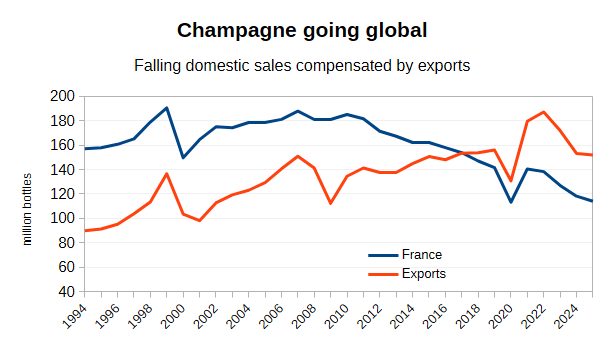
Champagne shipments fall for third year in 2025 to 5-year low

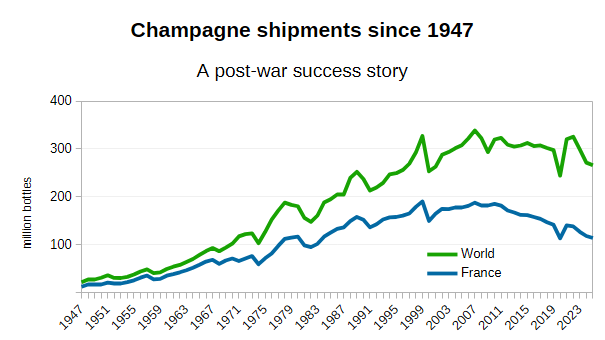
Champagne shipments declined for a third year in 2025, according to annual data published by Comité Champagne.


The number of shipped bottles fell to 266 million from 271.4 million, the trade group representing Champagne growers and producers said in a Jan. 17 report.

Shipped volumes were the lowest since 2020, when the Covid-19 pandemic caused a slump in trade and consumption, and down from a post-Covid peak of 325.5 million bottles in 2022, according to data from the Comité Interprofessionnel du Vin de Champagne.

Champagne demand has been under pressure due to changing drinking habits and competition from cheaper sparkling wines such as Prosecco, as well as the broader impact of inflation, economic uncertainty and tariffs.

In France, the biggest single market for Champagne, shipments fell for a fourth year to around 114 million bottles, vying with 2020 for the lowest volume since the early 1980s. Comité Champagne says the country remains an “absolute priority for the industry,” and the trade group’s co-President Maxime Toubart said the French market must be strengthened.

To put the recent slowdown in context, Champagne has been a massive post-World War 2 success story for the French wine industry. In 1960, Champagne shipped around 49 million bottles, of which more than two thirds stayed at home. Shipments had doubled by 1970 to 102 million bottles and had doubled again by 1986, boosted by rising domestic consumption and a growing export share.

The number of exported bottles caught up with domestic Champagne shipments in 2017, and hasn’t dropped below local consumption since.

Bordeaux’s Worst Mildew in Memory to Reduce Wine Output

The outbreak of downy mildew hitting the vineyards of Bordeaux this year may cut wine grape production in the growing area by at least a fifth.

In the northern Aquitaine region, which includes Bordeaux, almost all inspected vines had mildew, a weekly report on grape health showed. More than half of grape clusters in affected plots showed signs of the microbial disease, and a third of grape berries in those bunches were tainted.

The numbers for affected vineyards (96%), tainted clusters (58%) and grapes with mildew (35%) suggest potential grape production for Bordeaux may be cut by at least 20%.

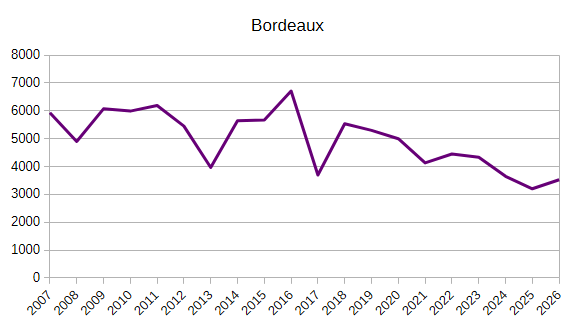
Bordeaux produced 4.5 million hectoliters of wine in 2022, a smaller-than-average vintage, data from France’s Agriculture Ministry shows. A drop of 20% versus 10-year average production of 5 million hectoliters would result in one of the region’s smallest vintages of the past decade.

Bordeaux wine sales totaled €3.5 billion in 2020, according to the local wine board. That suggests local winemakers may face at least €700 million in damage from mildew this year.

Worst in memory

The Gironde agriculture chamber earlier this month said mildew affected at least 90% of vines in the Bordeaux area, after weeks of unusually warm and humid weather. The chamber said the outbreak was the worst in memory for winemakers.

Downy mildew (“mildiou” in French) develops at temperatures between 11°C and 30 °C, with its thermal optimum around 25 °C, according to French crop-protection industry organization Phyteis. The disease first spreads on vine leaves, and grape berries are sensitive to mildew until the onset of ripening.

The agriculture ministry plans to release its first estimate of France’s wine production on Aug. 8, with comment on trends in growing regions. The ministry typically provides a regional breakdown in September.

Bordeaux vineyard prices have fallen in recent years, as some of the region’s less prestigious areas struggle with lackluster demand. That’s even as average prices for wine property in France have risen to record levels.

Buying a French Vineyard Was Never More Expensive

As Champagne recovers, wine real estate in Burgundy and the Loire Valley continues to go strong, while Bordeaux falters.

Pursuing a dream of becoming a winemaker in France has never been more expensive.

Vineyard prices in France rose 2.2% to a record in 2022, according to Safer, France’s rural property agency. The Champagne region partially recovered from a year-earlier slump, while wine property continued to appreciate in the most prestigious grape-growing areas of Burgundy and the Loire Valley. The Bordeaux region was an outlier, with values falling in some well-known wine areas.

Buying a hectare of vines, about the area of a rugby pitch, cost an average €151,200 in France last year, according to data published by Safer on May 25. Real estate demand in Champagne benefited from strong sales for the region’s sparkling wine, with record volumes last year following a rebound in 2021, according to Safer.

“After three years of decline, the average price per hectare in Champagne rises again, in a very active property market,” Safer said.

Excluding Champagne, the cost of vines with a French appellation of origin (AOP) increased 2% to a record €81,600 per hectare. The high cost of Champagne property means the region accounts for half of the wine real estate value in France, while making up 7% of the country’s planted AOP vineyard area.

Vineyard deals top €1 billion

The number of wine property deals rose 1.1% to 9,490 in 2022, the most transactions in 15 years, with 2.35% of France’s vineyard area changing hands. The value of the area that changed owner fell 7.9% to €1.01 billion, weighed down by wine real-estate transactions in the Bordeaux region falling 36% to €224 million.

In Champagne, the average price per hectare rose 2.4% to €1.07 million. For Burgundy’s Côte-d’Or growing area, average values rose 12% to €887,200 per hectare, boosted by a 15% jump for prices of both red and white premier cru, or first growth, vineyards.

In the Loire Valley, the price of a hectare of vines in Sancerre jumped 24% to €260,000, while Menetou-Salon registered a 13% increase to an average €90,000 per hectare.

The pricey vines of Sancerre.

“Since seven years, the increase in the average value has been driven by the regular increase of prices in the prestigious appellations, which benefit from an attractiveness as a safe haven for wealthy investors,” Safer said.

Average prices in the Bordeaux region fell 3.1% to €127,900 per hectare, with wine property values falling in areas including Pessac-Léognan and Médoc. Safer said the decline is due to commercial difficulties for the Bordeaux and Côtes de Bordeaux appellations, with vineyard prices stable in more prestigious areas such as Pauillac and Pomerol.

As France Grows to Love Rosé, Red Wine and Champagne Face Pressure

With Generation Z coming of age, France is increasingly serving rosé and white wine rather than the traditional ‘ballon de rouge’

Whatever France’s reputation as red wine country, turns out French drinkers are more likely to be found sipping a glass of pale yellow-gold or pink wine these days.

Rosé wine volumes sold in French supermarkets and hypermarkets doubled between 1994 and 2020, data published by crop office FranceAgriMer show. White wines registered comparatively pedestrian 13% volume growth over the period. By contrast, red wine sales fell by more than half.

French hypermarket and supermarket shoppers are turning to rosé wine and away from reds.

Food retail is where most French consumers buy their wine, ahead of specialty stores, bars and restaurants, surveys show. Combined sales volumes of rosés and whites in hypermarkets and supermarkets overtook red wine in 2018, according to the data gathered by Symphony IRI.

Generational shift

There’s clearly a generational shift. One in every three glasses of wine consumed by Generation Z and Millennials is a rosé, according to a Wine Intelligence survey ahead of February’s Vinexpo Paris. That compares with less than one glass in four for wine drinkers aged 55 and over.

The popularity of pink wine is a bit of a French thing. The country accounts for 35% of global rosé intake, according to an observatory by the Provence wine board with FranceAgriMer. That compares with France’s 11% share of overall global wine consumption.

White and rosé wines were the preferred purchase for French shoppers in the 18-to-24 year age range in an OpinionWay survey from September 2021, with less than one in ten choosing red wine. Champagne was the wine to buy for 17% of Gen Z-ers of drinking age.

This colour shift is happening in the context of a vertiginous drop in French wine drinking in recent decades. Average wine consumption fell to 36 liters per capita in 2018 from 71 liters in 1990 and 128 liters in 1960, statistics office Insee says.

Drinking less, but better

Less drinking has also gone hand in hand with a shift away from wines for daily consumption, the “vins de consommation courante,” to higher-quality bottles. An Ipsos survey in October 2021 found consumers were spending an average €11.70 a bottle, an increase of €4.20 from six years earlier.

Red wine producers may take some consolation from these higher prices, which have helped make up for lower sales volumes. The value of red wine sold in French supermarkets and hypermarkets stood at 1.95 billion euros in 2020 from 1.68 billion euros in 1994.

Still, the gains for reds pale in comparison with the jump in value of rosé sold through food retailers, which climbed fourfold to 1.14 billion euros in the same period. White wine sales in supermarkets and hypermarkets more than doubled to 927 million euros, the FranceAgriMer data show.

Growth for rosés, and whites for that matter, has been particularly strong in the category of IGP wines, for Indication Géographique Protégée. Consumers are clearly happy seeking out, say, a rosé produced from cinsault and grenache grapes in the IGP Pays d’Oc, or a white chardonnay from the IGP Val de Loire.

While business in IGP wines has been dynamic, in value and to a lesser extent in volume, the Appellation d’Origine Protégée category has been more lackluster. Typically considered a step up in quality, AOP wines have seen falling volumes, and spending also took a turn for the worse in recent years.

The ramp-up for supermarket sales of rosé coincides with a decline in Champagne shipments in France since 2010. While correlation is not causation, quaffing of bubbly and blush does appear to be heading in opposite directions.

As French Wine Harvest Recovers, Champagne Is the Big Winner

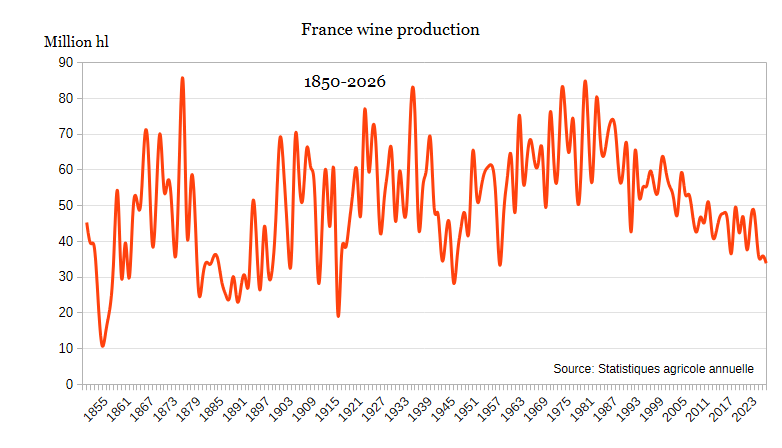
French wine production will jump 20% this year, recovering from last year’s devastating spring frost, based on final estimates from the Agriculture Ministry.

Winemakers in France will produce an estimated 45.4 million hectoliters this year, equivalent to about 6 billion bottles and in line with average yearly output for the past decade. In a year made decidedly unaverage by record heat and drought, growing regions that received rain came out on top.

Champagne, Burgundy and Languedoc-Roussillon will produce some of their biggest vintages of the past fifteen years. That will help rebuild stocks, meet rising demand and possibly provide some price relief for consumers. In Bordeaux, a combination of frost, hail and drought resulted in a difficult year.

“The rain deficit from spring and the strong heat in summer reduced the potential in several areas, particularly in the South-West and Alsace,” the ministry said in a report this week. “However, several vineyards held up better, such as Charentes, Champagne, Burgundy and Languedoc.”

Last year’s wine harvest of 37.8 million hectoliters was one of the smallest of the past 60 years, after frost in April damaged almost the entire French growing area, to varying degrees.

And the winner is… Champagne

Champagne was the biggest winner of the 2022 weather lottery, after a prior year marked by losses to spring frost and disease.

Areas of higher rainfall on Météo-France’s summer precipitation map neatly overlaid the Champagne growing region. Rain in June charged soil moisture, allowing grapes to develop despite the summer heat, while disease was absent.

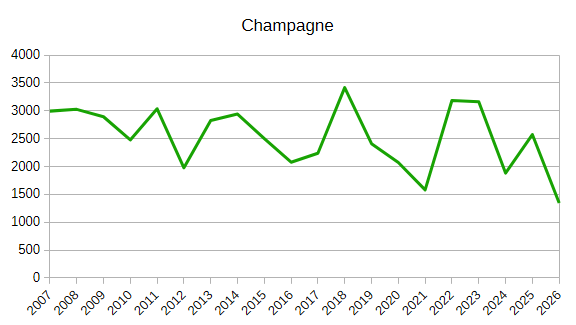
The volume of wine under the “Champagne” label will almost double to 2.98 million hectoliters from 1.54 million hectoliters a year earlier, the ministry estimates, about 190 million additional bottles. That will help meet rising demand for the sparkling wine, after three years of below-average production.

A “bountiful, high-quality harvest” means winegrowers were able to rebuild reserves that had been substantially depleted by the 2021 season, Comité Champagne said in September. Champagne shipments rose 32% in 2021 to 322 million bottles, recovering to pre-Covid levels, and market demand was up 9% year to date at the end of August, according to the wine board.

Burgundy good, Beaujolais bad

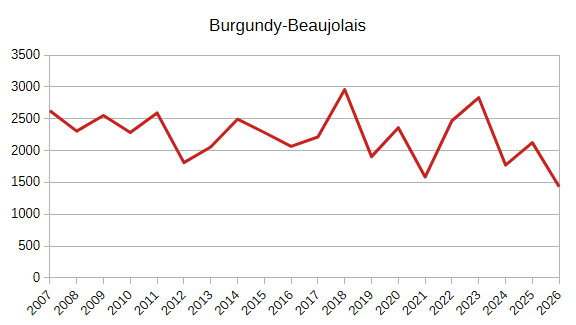
In Burgundy, production was well above the five-year average, and grapes were healthy, while volumes in Beaujolais were below average, hurt by drought and hail. In the combined Burgundy-Beaujolais region, the volume of wine with a protected designation of origin (AOP) will jump an estimated 59% to 2.41 million hectoliters.

Languedoc gets rain boost

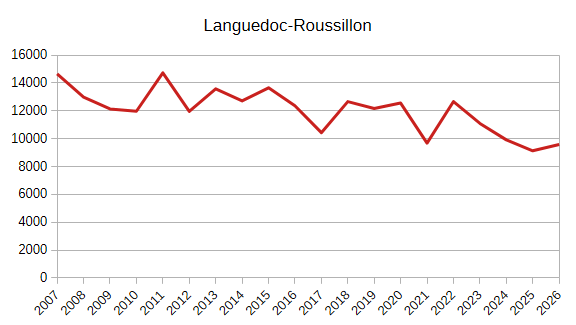
In the south, Languedoc-Roussillon produced its biggest vintage in seven years, boosted by late summer rains, and as last season’s freezing damage stimulated fruit production in 2022. The region is France’s biggest production area by volume, and much of its wine is sold as bulk.

The region’s overall production rose 36% to 13.18 million hectoliters, according to the ministry’s estimates, with the share of AOP wine at 2.34 million hectoliters.

With higher volumes in Languedoc-Roussillon and a forecast for a bigger vintage in Italy, French bulk wine prices have been under pressure. Values for bulk reds and rosés have come down to around €0.90/liter in the first half of November from more than €1 in June and July, according to prices tracked by FranceAgriMer.

Bordeaux suffers again

Bordeaux suffered a third year of below-average production, battered by frost in April, hail in June and a summer-long drought. The volume of AOP wines is forecast to rise 10% to 4.23 million hectoliters, one of the smaller vintages of the past fifteen years.

Charentes going steady

In Charentes, rain toward the end of summer helped make up for frost and hail damage, and total wine volume was little changed from last year at 9.57 million hectoliters. Most of the locally produced wine is distilled into spirits, with Cognac makers such as Rémy Martin and Hennessy relying on the region’s ugni blanc grapes for raw material.

Industry lobby Bureau National Interprofessionnel du Cognac has been pushing to expand the Charentes vineyard to meet rising demand, with nine liters of wine required to produce one liter of spirits. Cognac shipments jumped 16% in 2021 to 223 million bottles.

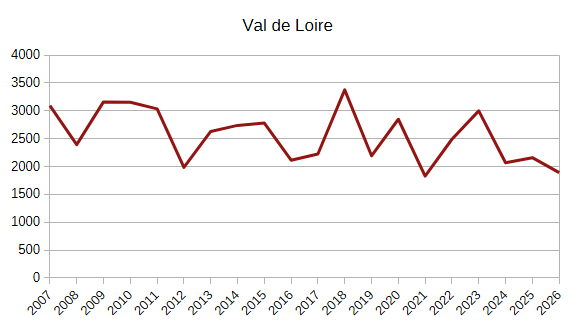
Drought hurt winegrowers in Alsace, Savoy and the Loire Valley, with harvests below the five-year average. The Jura region, of “vin jaune” fame, recovered from devastating frost in 2021, with volumes rising more than threefold to produce one of the biggest vintages of the past fifteen years.

« Older posts

© 2026 Wine Graphs

Theme by Anders NorenUp ↑